


When it comes to pairing drinks with cheese, wine is often the natural choice. It’s what many of us will default to pouring alongside a cheeseboard, shaped by long-standing traditions and those familiar moments of opening a bottle, passing plates and lingering over a final slice.
What many people don’t realise is that beer also works exceptionally well with cheese. With its breadth of styles, refreshing carbonation and shared roots in fermentation, beer is a natural pairing, yet it’s still frequently overlooked in favour of wine on the cheeseboard.
To explore why beer deserves a place at the table, we spoke to Patrick McGuigan, a UK-based cheese writer and educator who has travelled widely to meet cheesemakers, maturers and cheesemongers, from the Swiss Alps to the pastures of Vermont. Patrick writes extensively on cheese for national publications including The Telegraph and Delicious, is the author of The Philosophy of Cheese, The Cheese Life and One Cheese to Rule Them All, and regularly hosts cheese talks, tastings and events.
Patrick also teaches with the Academy of Cheese and collaborates with the WSET School London on tasting events, including cheese and beer sessions. He brings a deep understanding of flavour and fermentation, alongside a practical, open-minded approach to pairing that prioritises confidence and enjoyment over rigid rules.
In this Q&A, Patrick shares why beer works so well with cheese, the principles he returns to when pairing, and how anyone, from the curious beginner to the confident taster, can start exploring beer on the cheeseboard with confidence.
For anyone who might be new to your work, how would you describe your role in the world of cheese?
I’m a man of many hats. I started out as a journalist, and I still am a journalist and food writer. About 20 years ago I worked in restaurants and wrote a lot about food and dining, and around 15 years ago I began focusing more specifically on cheese.
Wine and beer actually played a part in that move into cheese writing. I was always a big wine lover, not professionally at first, but visiting vineyards and spending more money on wine than I probably should. Around the same time, about 10 to 15 years ago, the craft beer scene was really taking off, and I was going on brewery tours and becoming increasingly interested in flavour and a sense of place.
That idea of flavour and place, which you particularly get with wine, is very relevant to cheese. Once I started getting into cheese, I realised there were all these overlaps with wine and beer that really spoke to me.
So now I’m a cheese writer. I write for newspapers and magazines such as The Sunday Times, The Telegraph and Delicious. I’ve written three books: The Philosophy of Cheese, The Cheese Life, and more recently One Cheese to Rule Them All.
I also do a lot of teaching and talks. I teach with the Academy of Cheese, which has a four-level qualification structure similar to WSET, and I teach at the WSET School in London. I’ve done lots of cheese and drinks events there too, including cheese and beer nights, which I’ve really enjoyed.
I also have my WSET Level 3 Award in Wines, which I’m rather proud of. I haven’t taken on the Diploma yet, but it’s an ambition.
Many people automatically think of wine when they think about pairing with cheese. From your experience, what makes beer such an exciting and often underrated match?
Beer is massively underrated with cheese, and I’d actually argue that beer is easier to match with cheese than wine.
That might sound controversial, because wine and cheese is the classic combination, but I’ve spent a lot of time sitting down with cheese and different drinks and tasting my way through things, and beer just works. It’s very hard to find a bad cheese-and-beer match. It’s very easy to find a bad cheese-and-wine match.
Wine varies hugely. Vintage, vineyard, producer, cru. There are so many variables. Beer is more consistent. It also usually has carbonation, which works really well with cheese because it’s refreshing. Cheese is a rich food, and bubbles help cleanse the palate.
Beer also often has bitterness, which again is quite cleansing with cheese. And if you look at beer flavour wheels and cheese flavour wheels, they’re very similar. You see farmyard notes, fruit, spice and vegetal flavours. There’s a lot of overlap and a lot of complementary flavours.
Beer is also more accessible. You can buy a world-class beer for five or six pounds, which you’re unlikely to do with wine. You can open several beers alongside a cheeseboard and have fun mixing and matching, which most people wouldn’t do with wine.

Patrick McGuigan at a recent beer and cheese pairing.
When you’re pairing cheese with beer, are there any key principles you tend to rely on?
Some of the same principles as wine apply. Matching intensity is a good starting point. More powerful cheeses tend to work best with stronger beers, while lighter cheeses suit lighter styles.
Aged Goudas work really well with stronger Belgian ales. Lighter beers like lagers and wheat beers work well with younger, softer cheeses. Belgian-style wheat beers in particular can be very refreshing and light.
That said, there are curveballs. A crisp Pilsner can work really well with a strong Camembert because there’s something neutral and cleansing about it that cuts through those funky, cabbagey, garlicky flavours.
I’d always err on the side of experimentation. Give things a go. You can be surprised by what works.
There’s also the idea that what grows together goes together. British beers work very well with British cheeses like Cheddar, Cheshire and Lancashire. Strong washed-rind cheeses from northern France or Belgium work brilliantly with strong Belgian ales. They’ve naturally been paired together over centuries.
Those washed-rind cheeses are often very hard to match with wine. They tend to stamp all over it, but beer really holds its own.
Could you walk us through a few cheese styles and the kinds of beers you feel work well with them?
Blue cheese with stout is the easiest cheese-and-beer match you’ll ever find. Stilton and Guinness is a beautiful thing, but any stout or porter will work well.
Blue cheeses tend to be salty, and darker beers have a chocolatey sweetness from roasted malts. Sweet and salty works. It’s the same idea as blue cheese with dessert wine.
I once served blue cheese and porter to someone who said they didn’t like either. When they tried them together, something just clicked. There was an elevation, which is exactly what you want from a great pairing.
IPAs work very well with alpine cheeses like Comté and Gruyère, especially modern IPAs with tropical fruit flavours. Those cheeses are nutty and slightly sweet, and they work beautifully together.
English beers like Best Bitter are fantastic with Cheddar, Wensleydale or Lancashire. These are classic pub food combinations for a reason.
Belgian-style wheat beers and saisons work very well with goat’s cheeses, particularly younger, lactic styles. Saisons also work well. They often have floral or spicy notes that match those grassy, fresh flavours in goat’s cheese.
A lot of what we do at WSET is about helping people build confidence in describing flavour. In your experience, what helps people talk about cheese more confidently?
It’s really about fundamentals and structure. At Level 1 of the Academy of Cheese, the first thing we teach is how to taste.
We look at the cheese, feel the texture, smell it, and then taste it. Initially, we focus on simple things like acidity, sweetness, saltiness, bitterness and savoury notes, and then build up to more complex flavours.
Once people have the words and a structure, they realise they do know what they’re tasting. A little bit of knowledge goes a long way.
We also explain how cheese is made. Once people understand it’s a fermented food, like wine, beer, coffee and chocolate, that knowledge really helps them make sense of flavour.
Cheese is also very accessible. People buy it all the time, and by trying different styles and changing what you buy, you can quickly build confidence and understanding.
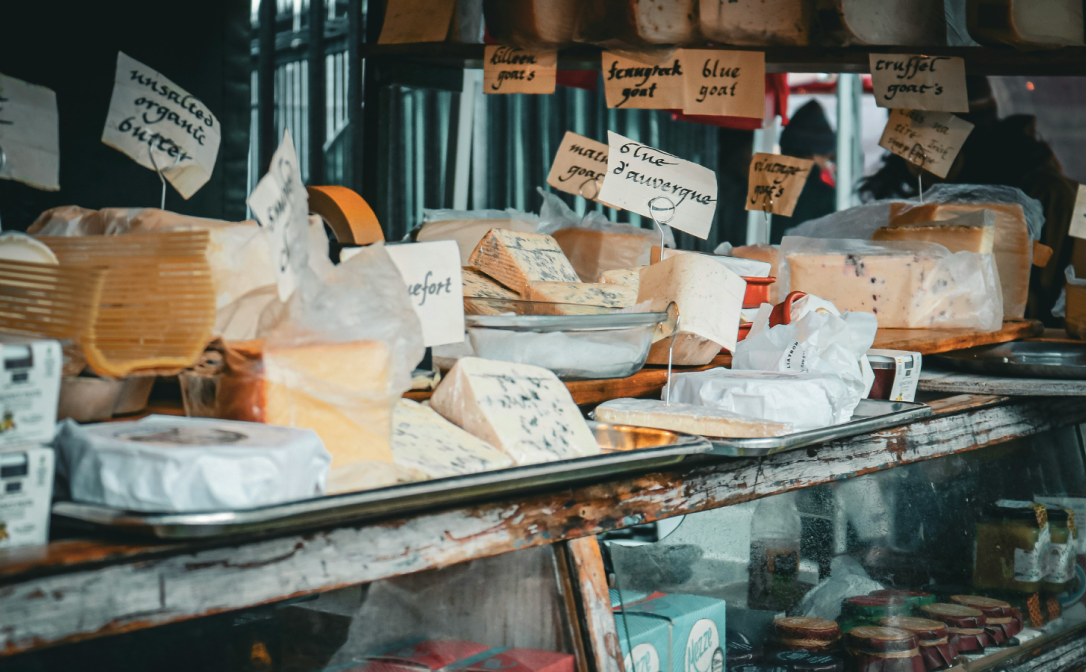
An abundance of cheeses to choose from.
Any practical tips for people trying beer and cheese together for the first time?
Temperature is really important. Cheese should be at room temperature, so take it out of the fridge at least 30 minutes beforehand. Beer doesn’t always want to be fridge-cold either. Some styles really benefit from being served a little warmer.
It’s also worth paying attention to how you pour beer, especially bottle-conditioned beers with sediment. Some beers are meant to be hazy, some aren’t, so it’s worth checking how they’re best served.
How you cut cheese matters too. Don’t cut the nose off a wedge. That takes the heart of the cheese. You want cross-sections from rind to centre so people can taste the full range of flavours.
Some people are cheese purists and don’t want accompaniments. I’m not one of those people. I like crackers, chutneys, honey and nuts. Playing around with flavours is part of the fun.
And beyond beer pairings, what are your go-to tips for putting together a great cheese board?
The orthodox advice is variety. Different milk types, textures and styles all have a role to play. In the UK, the classic three cheeses are Cheddar, Brie and Stilton.
Odd numbers tend to work better visually. Three, five or seven cheeses usually look best.
If you go bigger, bring in different milk types such as goat, sheep or buffalo, and different styles like washed-rind cheeses, leaf-wrapped cheeses or something a bit unusual.
That said, you don’t have to follow the rules. If you love goat’s cheese, have five goat’s cheeses and compare them. Think of it as a horizontal tasting.
Cheese is meant to be fun. There are rules, but you can make up your own.
Beer’s ability to work so naturally with cheese comes down to understanding flavour, balance and style. These are the foundations of WSET’s beer qualifications, which guide students through beer tasting, production and styles in a clear, structured way.
If you’re curious to explore beer in more depth, from how different styles are made to how they work with food, discover WSET Level 1 and 2 Awards in Beer.
One Cheese to Rule Them All, Patrick’s most recent book, is a celebration of 100 award-winning cheeses from around the world, shaped by decades of tasting, travel and judging at the World Cheese Awards. Co-authored with fellow judge Carlos Yescas, it explores how cheese is made, how it tastes, what to drink with it, and the people and places behind each cheese.
