


A high-level qualification designed for passionate enthusiasts, the WSET Level 3 Award in Wines builds on content you’ve already explored in your Level 1 and Level 2 wine courses.
By combining a systematic approach to tasting with advanced wine education, specialist educators guide you to a deeper level of knowledge, so you emerge with a thorough understanding of the factors that influence the style, quality and price points of the world’s principal wines.
Whether you study at WSET School London, online or at one of our global course providers, you are recommended to dedicate a minimum of 51.5 hours of individual study time ahead of your exams, ensuring you absorb information at a steady pace.
But it’s not just your wine revision timeline or techniques that makes the difference in Level 3 exam success. How you approach writing your exam can make a difference to how you excel.
WSET Level 3 in Wines exam format
The Level 3 exam is more in-depth than the Level 1 and Level 2 exams, and consists of two parts:
- A closed book exam
- A blind tasting
The closed book exam is comprised of two sections: 50 multiple-choice questions and four short-answer questions. The first section is designed to assess your knowledge and understanding of the wine regions and topics studied across the course. The second assesses your ability to apply that knowledge. You will have two hours to complete the exam.
The blind tasting segment must be completed within 30 minutes and features two still wines. Using the systematic approach to tasting, your aim is to accurately describe each wine and draw conclusions about its quality and readiness to drink based on your observations.
You will need to achieve a minimum mark of 55% on both segments of your written exam, and a combined mark of 55% across both wines on your tasting exam, in order to pass your WSET Level 3 Award in Wine.
Wine exam techniques: breaking down the question
Before you get stuck into writing your exam, take a few moments to get to grips with what the question is actually asking of you.
Each question has multiple parts, with each one giving you clues about how you should answer. Review the question using a series of steps, and you’ll be able to respond more effectively.
1. Identify the command verb
Before you begin to write start by identifying the command verb in your question. This will guide both the structure and content of your answer.
Examples of command verbs are:
- Identify. Questions that ask you to ‘identify’ are asking you to provide a straight-forward answer by naming or listing the required information, without additional details or explanation.
- Describe. This requires giving a detailed account of the characteristics, features or aspects of the subject. Think of it like painting a clear picture with words.
- Explain. If you are asked by your exam to ‘explain’, you must clarify how and why something happens or is the way it is. Offer a comprehensive response that includes reasoning, connections and justifications.
Match your response to the command verb in your question, and ensure your answers are as direct and relevant as possible. For example, if you are asked to ‘identify’, avoid unnecessary elaboration. If you’re asked to ‘explain’, include more depth and complexity.
2. Focus on the question
Once you’ve identified your command verb, determine what it is the question is actually asking. Maybe it’s asking about the characteristics of a certain wine, a winemaking process or a grape-growing practice.
3. Spot any context or conditions
Some questions are broader than others and many may set a context or condition that you should consider when answering. For example, you may be asked to include certain wine styles, regions or grape varieties.
4. Determine the detail required
Not every question requires an in-depth response. Look at the marks allocated to a question before you begin writing. Those worth more require more detail or complexity in response.
5. Link cause and effect
When questions ask you to ‘explain’, be sure to include an explanatory sentence that links cause and effect. Use words like ‘therefore’ or ‘because’.
A Model Exam Question & Answer
Let’s put the above into practice by taking a look at a sample question, of the sort you may see in the short-form written section of your Level 3 exam.
Example:
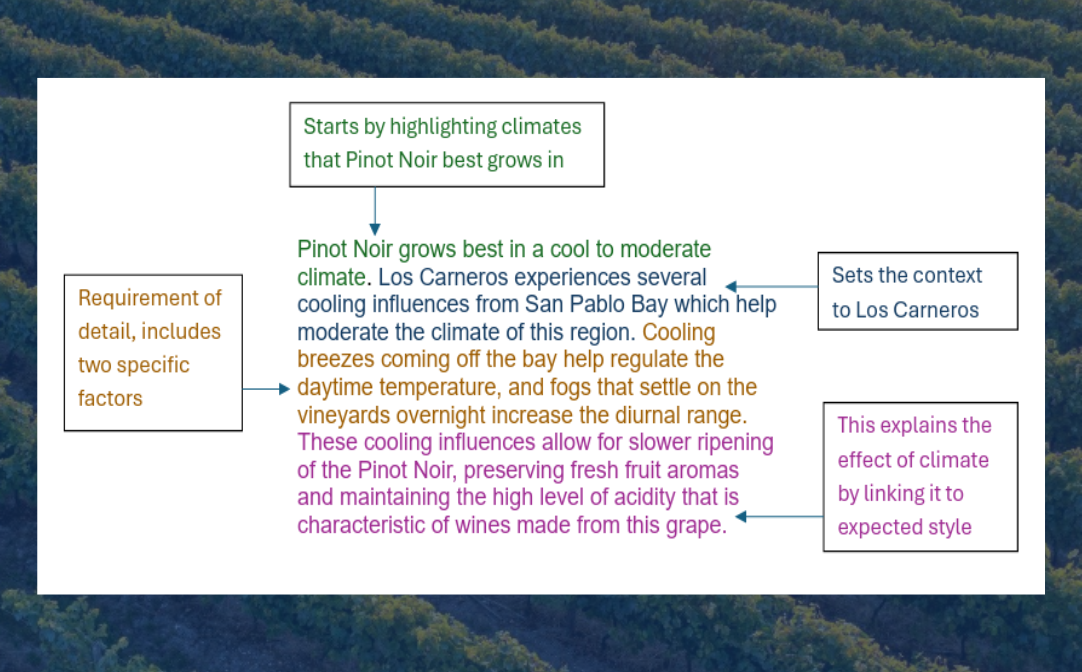
Explain how climactic factors in Los Carneros influence the style of Pinot Noir produced. (5 marks)
- Identify the command verb. The command verb is ‘explain’, so you will need a comprehensive answer that includes reasoning, connections and justifications.
- Focus on the question. Your discussion point is the climactic factors that influence Pinot Noir in Los Carneros.
- Spot any context or condition. We only care about climate factors here, and those specific to Los Carneros.
- Determinethe detail required. The question is worth five marks, which is enough to require sufficient detail. Plan to include two climactic factors and their impact on the style of wine produced in Los Carneros.
- Link cause and effect. As this is an ‘explain’ question you will need to effectively link the climate to the style of wine to receive maximum marks. Be sure to use linking phrases such as ‘therefore’ and ‘because’.
Here’s an example of an answer that would receive the full five marks:
More Level 3 exam and wine study tips
- Manage your time. Skim your exam at the start to identify the questions worth the most marks – this is where you should allocate the majority of your time. For example, if the exam is graded out of a 100, spend a quarter of your time on the question worth 25 marks and just a couple of minutes on a question worth two marks.
- Don’t dwell. If you an encounter a question that you aren’t sure about, move on and come back to it later.
- Leave nothing blank. Never leave questions unanswered at the end of the exam; a partial answer is better than nothing, and may score you marks you weren’t expecting.
- Sketch out answers before writing. If you need to collect your thoughts or aren’t sure how to immediately summarise your answer to a question, take a few moments to make notes first before diving into writing. It helps clarify things in your mind and your answer will read more clearly, too.
- Brush up on common errors. Our dedicated tasting exam blog post outlines the most common errors in your Level 3 tasting exam and includes more tips for success.
Take the next step in wine qualifications
Whether you are new to the world of wine qualifications or are a current a WSET Level 3 student preparing for your exam, you’ll find a range of resources on the WSET website.
Check out our related blogs on how to study wine and a systematic approach to wine region study. Or expand your knowledge of wine, spirits, beer and sake on another one of our range of specialist courses.
About the author:
Alicia Miller is an award-winning travel writer specialising in food, drink, hotels, and wellness. She contributes to leading UK publications, including The Times, National Geographic Traveller, The Evening Standard, The Telegraph, The Independent, Decanter, and more. She is also the Travel Editor at Woman & Home magazine and has been recognised with multiple industry awards, including AITO’s Travel Writer of the Year in 2022.
Additional reading and watching
Are you ready for the WSET Level 3 Award in Wines?
How to taste wine - the WSET Level 3 Award in Wines way (video)
