


As one of the most ambitious wine qualifications in the world, the WSET Level 3 Award in Wines is an exciting milestone in your vinous journey. Building on your existing wine education, you’ll learn about the principal wines of the world in-depth, the regions they come from and the way they are made.
Level 3 is an advanced course designed for dedicated wine enthusiasts, which culminates in a two-part written exam and blind tasting test. At first this might sound intimidating but having a structured study plan can make all the difference to success.
In this, the first of three dedicated blogs outlining how to study for your Level 3 Award, we lay out how to tackle your revision over an eight-week study plan, and highlight key wine study tips too.
Don’t forget to check out blog parts two and three, dedicated to systematic wine region study, and exam approach. For more detail on the blind tasting element, review the systematic approach to tasting and our top tasting exam tips.
How to study wine: take it slow
Little and often: that should be your study plan mantra. Whether you are studying Level 3 at WSET School London or taking your wine courses online or through a worldwide approved provider, your plan should look similar, with a recommended minimum of 51.5 hours of individual study.
That might sound like a lot, but when broken down it’s very manageable. Spread your studies across a period of two months, and it’s about seven hours per week – an average of less than one a day. Suddenly wine revision doesn’t sound so daunting, right?
Eight-week study plan for your WSET Level 3 Award in Wines
We’ll go into more detail in our second Level 3 exam blog post but your eight-week study plan should look something like the following:
- Week 1: Tasting Techniques, Storage and Service, Natural and Human Factors in the Vineyard
- Week 2: Human Factors in the Winery
- Week 3: France
- Week 4: Rest of Europe
- Week 5: Rest of World
- Week 6: Sparkling and fortified wines
- Weeks 7 & 8: Revision of previous weeks
Reading with intent: tips for effective textbook reading
How you study is just as important as how much you study, and when.
For information to be absorbed you need to read your texts actively and effectively.
When you read a novel or a news story, you’re usually reading passively, letting information move through the mind without the aim of retention or engagement.
Reading when studying for an exam should be different. Try these strategies to help the information stick:
- Keep distractions to a minimum. When you’re reading, give it your full attention. Background interruptions like television, phones or conversations all steal your focus away from the information you’re trying to soak up.
- Preview the chapter. Before diving into the body of the text, step back for a quick skim to gain a brief overview. Spend a few minutes noting headings, subheadings, any highlighted terms or diagrams which may be given emphasis. This will give you a sense of the main topics and points of interest in the chapter, and clues about the kind of information you should be retaining.
- Be an active reader. Active reading requires engaging with the material as you read. Ask questions of the information you’re taking in, make predictions in your mind about what might come next and, at the end of each section, summarise the content in your own words to reinforce understanding.
- Highlight and annotate. Once you’ve read and understood a section, skim back over the text and use a highlighter or underline pen to help main points jump out on the page. Write any thoughts or notes in the margins, too. This will make it easier for you to pull out key concepts when you’re revising later.
- Summarise section by section. Once you’ve finished reading a section or chapter, help what you’ve read stick by writing a summary at the end. This reinforces what you’ve read in your mind and helps your brain to process it.
Up your note-taking game
Along with effective reading, considered note-taking enhances your understanding and retention of the material you’ll be tested on in the WSET Level 3 wine exam.
There are many ways to take and organise notes efficiently, and each has its pros and cons. Consider some of the below, feeling free to adapt or even combine them as suits you:
1. Outline Method
This is a good one if you’re studying hierarchical or structured information. Using bullet points or numbers, organise your notes by main topic and subtopic.
Example:
Bordeaux Grapes
Merlot
- Most widely planted
- Earlier ripening
- Higher volume – inexpensive wine
- High quality wines – Saint-Émilion + Pomerol
Cabernet Sauvignon
- Late ripening
- Warmer sites
- Free draining soils – gravel
- Médoc and Graves
2. Cornell Method
Designed to get you to actively engage with the material while note-taking, this method combines a cue section, list of key points, comments section and questions to test yourself on later.
Example:
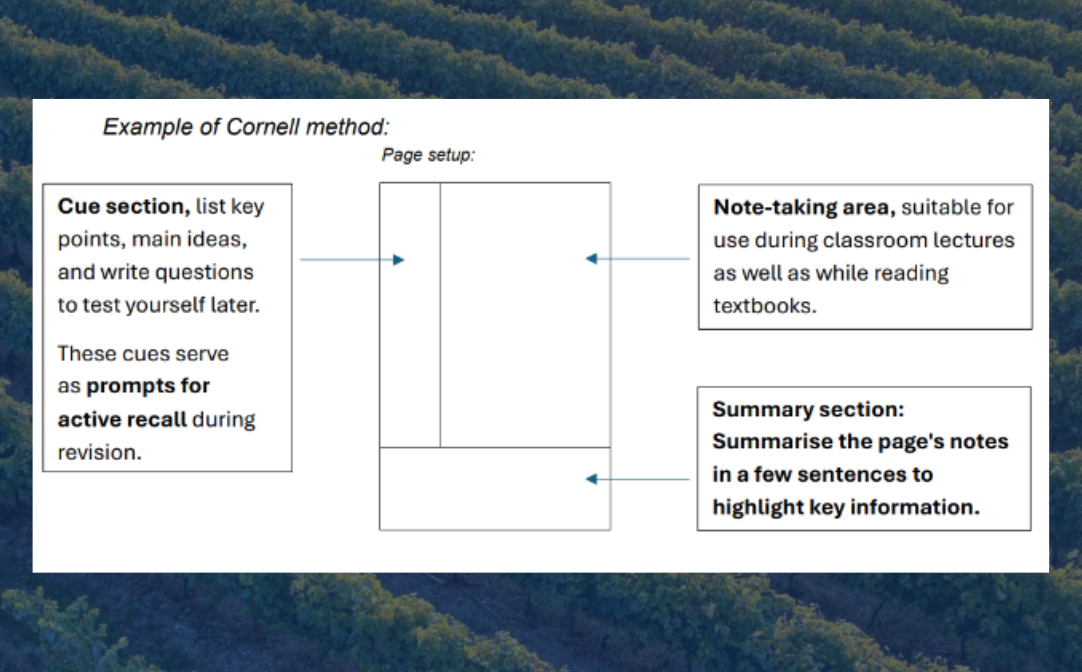
What’s handy about the Cornell Method is that you can have all your thoughts on the topic in one place. Written cues can also serve as prompts for active recall during your revision period, and the comments area for note-taking during classroom lectures.
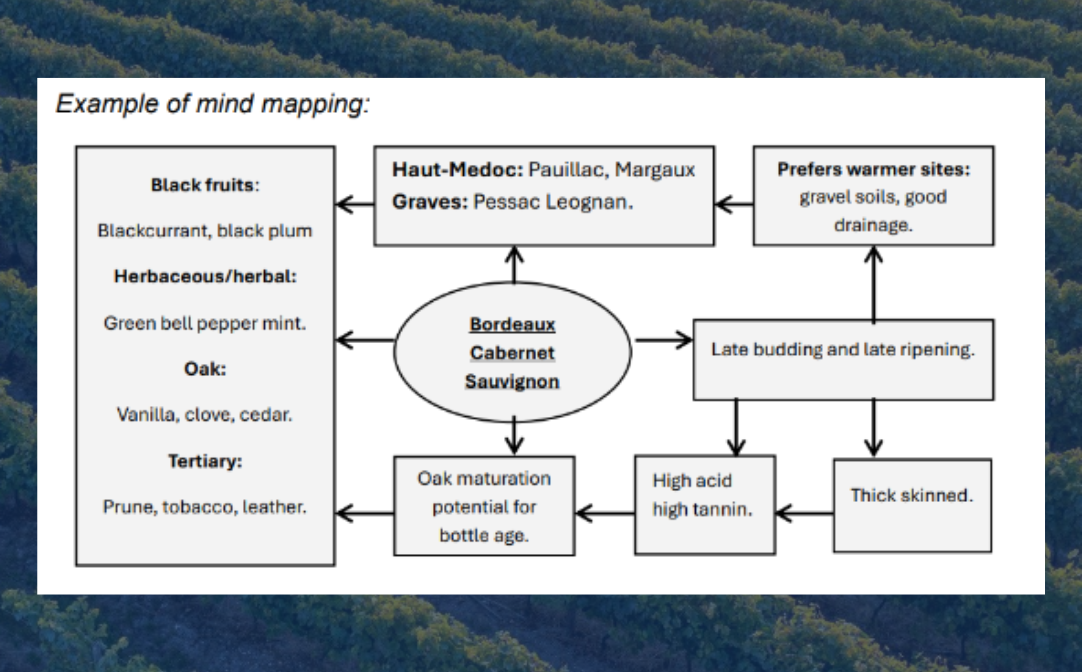
3. Mind Mapping
This form of note-taking is great for visual learners or any time you might want to understand the relationship between ideas. It creates a visual representation of the information by connecting each key concept with relevant branches.
Example:
Ace your WSET Level 3 Wine Exam
To be successful on your WSET Level 3 Award in Wine, active learning and regular review is crucial. Don’t leave revision until the last minute, instead tackle your reading and note-taking in bite-sized chunks to help information stick.
As well as studying and attending your tutored classes, you can prepare for your exam by familiarising yourself with its structure and required approach.
Not yet studying? Discover more about the Level 3 Award in Wine and find your nearest course provider here.
About the author:
Alicia Miller is an award-winning travel writer specialising in food, drink, hotels, and wellness. She contributes to leading UK publications, including The Times, National Geographic Traveller, The Evening Standard, The Telegraph, The Independent, Decanter, and more. She is also the Travel Editor at Woman & Home magazine and has been recognised with multiple industry awards, including AITO’s Travel Writer of the Year in 2022.
Additional reading and watching
Are you ready for the WSET Level 3 Award in Wines?
How to taste wine - the WSET Level 3 Award in Wines way (video)
How to ace the WSET Level 3 Award in Wines tasting exam
