


In this article, beer educator Natalya Watson explores one of the most talked-about techniques in modern brewing: dry hopping. From the science behind hop additions to the impact on aroma, flavour and appearance, this guide will deepen your understanding of how brewers shape some of today’s most expressive beer styles.
Beer labels are full of buzz words... we recently published a blog post exploring the many different types of hop-driven styles from APA, to IPA, to NEIPA and beyond. But the acronyms don’t stop there!
These beers can often have some additional letters on their labels, like DDH, which isn’t necessarily part of the style name, but indicates a particular production choice by the brewer.
That choice? Dry hopping, or “double dry hopping” as the extra D suggests. What is dry hopping and how might it impact the finished beer? Let’s take a step back and talk about hops first.
What are hops?
Hops are tall climbing plants that produce cones as they grow. The cones of the hop plant are harvested annually each autumn, and are used to bring both a bitter taste and a wide range of aromas to beer.
Which one we get, though, will depend on when those hop cones are added to the beer.
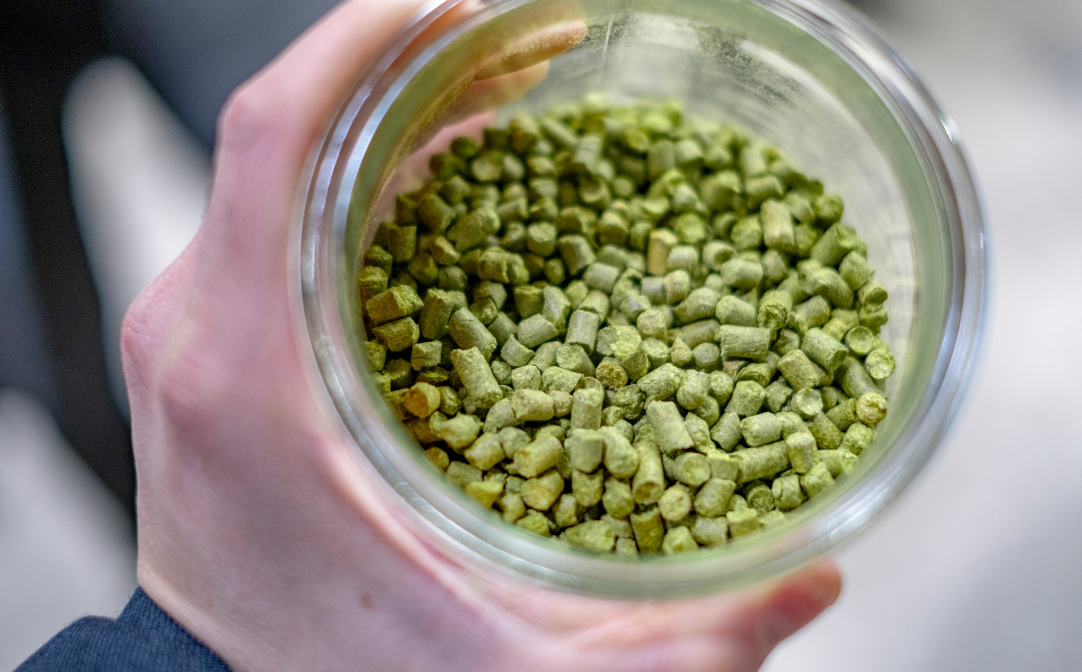
Hops can be used as pellets or in their original cone form
Hop additions for bitterness
Hops are typically added to the boiling stage of the brewing process. Boiling is a key step in the process because it helps to kill off any microorganisms that may have come into the brew from our raw materials or brewing equipment and it means that when we get to the fermentation stage a bit later, we can be sure that only the yeast we’ve added is busy at work (and we won’t get any unexpected, or off-flavours).
This step is also crucial for helping us to extract the bitterness from our hops. Why? The bittering components within the hops cones, called alpha acids, aren’t very soluble in water. But, with heat and time (boiling typically lasts 60-90 minutes), we’re able to convert those alpha acids to iso-alpha acids, meaning they can dissolve and impart their bitterness. So, adding hops at the beginning of the boil brings more bitterness to the finished beer.
Hop additions for aroma – on the hot-side
By contrast though, a long, rolling boil isn’t as helpful for the aromatic compounds from the hops’ essential oils, as they’re very delicate, or volatile, and essentially boil off during this stage. Therefoe, in order for the essential oils to have their aroma impact, we add hops again at the end of the boil to keep their aromas in, as well.
The end of the boil isn’t the only time we can add hops for aroma though. We can also add hops to a piece of equipment called the whirlpool, which is used the improve the clarity of the beer after the boil. Although no further heat is being applied in this step, the liquid is still very warm, so bitterness will build a bit, but the primary focus is on aroma.
Hop additions for aroma – on the cold-side
But we can also add hops even later - during or after fermentation - and it’s this process that we call dry-hopping.
I hear you wondering, why is it called dry hopping? Truth is, I’m not too sure. I’ve done some research and haven’t been able to find a conclusive explanation. But what’s more important for our purposes is the impact on the finished beer. So, how does it work?
Unlike boiling, which is conducted at very high temperatures, fermentation is conducted at much cooler temperatures – typically 18–24°C (64–75°F) for ale yeast – so we don’t have the heat required for the bittering isomerisation process to occur. As a result, dry-hopping is specifically focused on amping up aroma, as the essential oils don’t evaporate off.
The impacts of dry hopping
What kind of aromas should we expect? Hops can contribute a wide array of fruity, herbal and spicy notes, but most dry hopping uses American, Australian or New Zealand varietals, which can bring prominent citrus fruit, stone fruit, and tropical fruit character to the beers that use them… like our hop-driven American pale ales, IPAs and hazy IPAs.
Dry hopping doesn’t only impact a beers aroma though – it can also impact the appearance, adding haze. So, as the name suggests, a hazy IPA is one that has been heavily dry-hopped. (It’s also hazy from the inclusion of higher-protein grains like wheat or oats and the fact that brewers don’t filter the finished beer.)
Bonus points: biotransformation
When hops are added during fermentation, there’s another key beer ingredient still present – yeast. And these two ingredients can interact in a pretty interesting way. Through a process called biotransformation, yeast can essentially unlock new aromas from the hop compounds that weren’t present in the first place.
The processes are quite complex and technical so we won’t go into further detail here. But essentially this means there’s potential to get more hop aroma from less hop use – and with how expensive hops can be, you can imagine there’s a lot of exciting new research happening here, so watch this space!
The history of dry hopping
Given its use in many popular modern beer styles, it may lead you to think that dry hopping is a new technique, but it’s actually been around for centuries!
It’s thought that brewers in England – where the pale ale and IPA styles originated – had been adding hops into casks of beer since the 18th century. They weren’t quite using this technique for the same reasons we do today, though.
While we now use hops primarily for their bitterness and interesting aromas, in the past they were used for another reason – hops also contain antibacterial properties, so they were added to beer to slowing down its spoilage, effectively preserving it for longer.
These beers would have also had quite different aromas from our modern pale ales and IPAs, as English brewers would have been using traditional British hops, which are a lot more subtle than American, Australian and New Zealand varietals and bring notes of black tea, black current and earth.
Why do brewers dry hop?
The reason the dry hopping process is so popular today is for the massive aroma hit. But that can only be enjoyed when dry-hopped beers have been stored carefully (ideally refrigerated) and consumed as fresh as possible.
Curious to experience the impact? Look out for a dry-hopped or double dry-hopped, DDH, beer near you and give it a go!
As a note, there are some newer beer styles – like the Italian Pilsner – that use traditional European hops for dry hoping, adding punched up spicy, floral and herbal notes through this approach. Have fun tasting!
Lastly, what about wet hopping?
This is a different technique that’s not due to the timing of hop additions during the brewing process, but the timing of hop use relative to harvest. Most hops are harvested in autumn and dried so that they can be stored and used throughout the year.
But, during harvest season, some brewers experiment with using freshly picked, wet, whole cone hops straight from the harvest.
The aroma impact certainly isn’t as intense as that brought about by dry hopping, but it’s a fun once-a-year opportunity for brewers to understand how hop aromas might express differently depending on how those hops have been processed and when they’ve been added to the brew.
And if they’re added to the cold side, guess what that’s called? “Wet dry hopping”. Yes, the beer world is always evolving!
About the author
This blog post was written by Natalya Watson, Business Development Manager for beer in EMEA at WSET. Natalya is an award-winning beer educator with a passion for helping people explore and understand beer with confidence. She holds the IBD Beer Sommelier and Advanced Cicerone® certifications and is a WSET beer educator. She is also the author of Beer: Taste the Evolution in 50 Styles. Follow Nat on Instagram.
