


Inspired by a WSET webinar with Ana María Martín DipWSET, co-founder of the Canarias Wine Academy. Watch the webinar recording on the WSET Events Hub.
Few wine regions challenge expectations quite like the Canary Islands.
Located just 100 kilometres from the coast of Africa and more than 1,000 kilometres from mainland Spain, this Atlantic archipelago is home to some of the most dramatic vineyard landscapes in the world. Vines grow in volcanic ash, on steep terraces, across rugged mountainsides and at elevations that reach higher than anywhere else in Europe.
Yet the vineyards are only part of the story. The Canary Islands are home to ungrafted vines, rare grape varieties and vineyard traditions that have disappeared from many other wine regions. Centuries of isolation have helped preserve both plant material and growing practices, creating a wine culture that remains distinct within Spain and beyond.
Today, the islands are gaining international attention for wines shaped by volcanic soils, Atlantic influences and a remarkable diversity of native grape varieties.
A wine region shaped by isolation
The Canary Islands are one of Spain’s autonomous communities and consist of eight volcanic islands scattered across the Atlantic Ocean.
Their geographical position has always been both an advantage and a challenge. While proximity to Africa influences the climate, centuries of separation from mainland Europe helped preserve traditions, grape varieties and vineyard material that disappeared elsewhere.
Wine arrived with Spanish and Portuguese settlers during the fifteenth century. Viticulture expanded rapidly and, by the sixteenth century, Canary Islands wines were being exported throughout northern Europe. Demand was particularly strong in England, where the islands developed an important trading relationship.
The connection remains visible today. Canary Wharf in London takes its name from the ships that arrived carrying goods from the archipelago, including wine.
For a period, Canary Islands wine enjoyed extraordinary prestige. Then came changing trade routes, political tensions, growing competition from fortified wines such as Port and Madeira, and natural disasters that disrupted key export routes.
As a result, the region entered a long period of decline.
The fortunes of Canary Islands wine have changed considerably in recent decades. Producers have worked to recover native varieties, restore old vineyards and focus on quality. Growing international interest in volcanic wines has helped bring renewed attention to the region.
Why volcanic landscapes tell only part of the story
Volcanic origin is often the first thing people associate with the Canary Islands, but the islands' growing conditions are shaped by a combination of factors.
Trade winds play a crucial role. Known locally as alisios, these winds bring moisture that becomes trapped by the islands’ mountainous terrain, forming a layer of cloud known as the sea of clouds. This natural phenomenon moderates temperatures, slows ripening and helps preserve acidity.
The Canary Current provides another cooling influence, creating conditions that are far milder than many would expect at this latitude.
Altitude adds further complexity. Vineyards can be found close to sea level and at elevations reaching 1,700 metres above sea level. Some of Europe's highest vineyards are located on the islands, creating an extraordinary range of mesoclimates across a relatively small area.
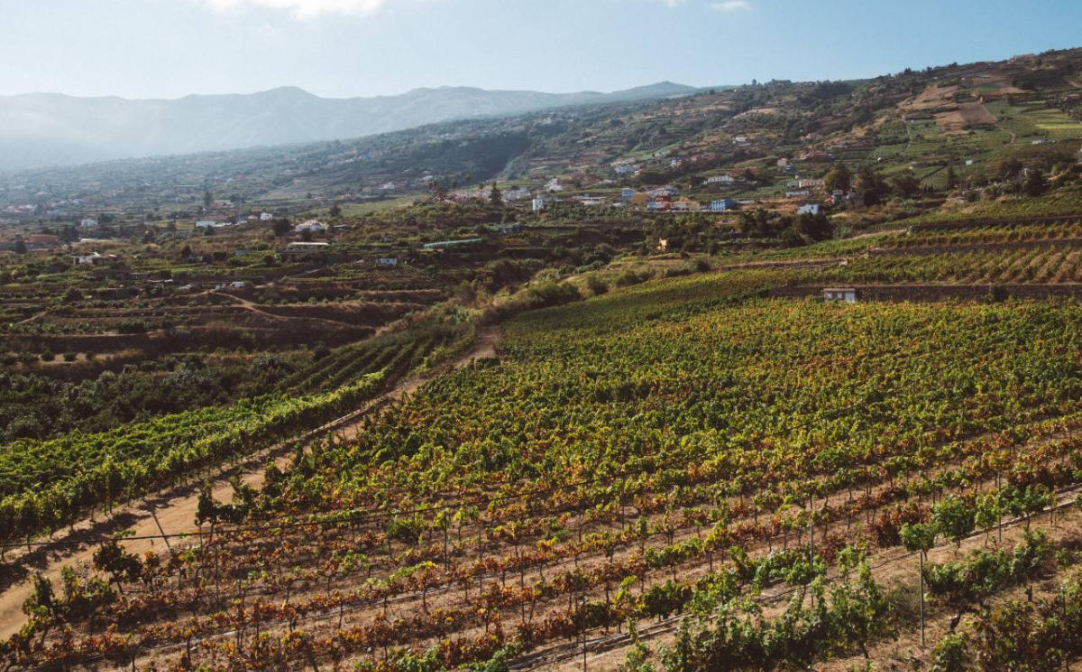
Image credit: Bodegas Tajinaste
Rainfall can vary dramatically too. Some vineyard sites receive very little precipitation, while others benefit from substantially higher rainfall depending on altitude and exposure.
The result is a region that cannot be reduced to a single climate profile. Every island, and often every valley, tells a different story.
The remarkable survival of ungrafted vines
One of the defining features of Canary Islands viticulture is the number of ungrafted vines that remain in production today.
The islands largely escaped the devastation caused by phylloxera, allowing historic plant material to survive. Some vineyards still contain descendants of vines planted centuries ago.
While isolated outbreaks have been identified in small, tightly controlled areas, strict quarantine measures and rapid intervention have helped prevent wider spread. As a result, ungrafted vineyards remain one of the defining features of Canary Islands viticulture.
This continuity has helped preserve an extraordinary diversity of indigenous grape varieties, many of which are found nowhere else in the world.
Vineyard traditions found nowhere else
One of the first lessons in understanding Canary Islands wine is recognising that the vineyards rarely look like anyone expects.
Across the archipelago, growers have developed training systems designed to cope with volcanic soils, wind exposure, steep terrain and limited water availability. The most famous example is found in Lanzarote's La Geria region. Following volcanic eruptions that covered the landscape with deep layers of ash, growers adapted by digging individual pits into the volcanic material until they reached fertile soil below. Stone walls were built around each vine to provide shelter from the wind, creating a landscape that looks almost lunar.
Elsewhere, vines may be trained close to the ground in rastras systems to reduce wind exposure and preserve soil moisture. In Tenerife's Valle de La Orotava, growers developed one of the world's most distinctive training methods: cordón trenzado. Long vine canes are braided together, sometimes extending for dozens of metres. Originally, this system helped manage vigorous growth while allowing farmers to cultivate crops beneath the vines. It remains one of the most visually striking expressions of traditional viticulture anywhere in the world.
Across many islands, steep slopes and terraces mean that vineyard work is still carried out largely by hand. Mechanisation is often impossible, making this a compelling example of what is sometimes described as heroic viticulture, where growing grapes demands persistence, ingenuity and physical effort.
Native grapes with stories that travelled the world
The Canary Islands are home to more than 35 recognised native grape varieties.
Among red grapes, Listán Negro remains the most widely planted. It produces wines with red fruit character, peppery notes and moderate tannins. Depending on the producer and site, it can be used to make everything from fresh, approachable wines to more structured styles with ageing potential.
One of the most historically significant varieties is Listán Prieto.
After arriving from mainland Spain and becoming established in the Canary Islands, it travelled onwards with missionaries to the Americas. There it became known under different names, including Mission in California and País in Chile. Its journey illustrates the role the Canary Islands played in the spread of grape varieties across the Atlantic.
Among white grapes, Listán Blanco dominates plantings. Although genetically identical to Palomino Fino, the variety expresses itself differently in the islands' growing conditions, often producing wines with higher acidity and greater aromatic intensity.
Malvasía Volcánica is another flagship variety, particularly associated with Lanzarote. Alongside other local grapes such as Vijariego, Marmajuelo, Gual and Albillo Criollo, it contributes to the remarkable diversity of grape varieties found across the islands.
Wine styles of the Canary Islands
The diversity of vineyard sites and grape varieties translates into an equally diverse range of wines.
Fresh white wines are among the region's signatures. Many are made for early drinking, while others gain texture and complexity through lees ageing or oak maturation.
Red wines range from light and vibrant styles to more structured examples made from varieties such as Tintilla, Baboso Negro and Negramoll.
Rosé wines are produced throughout the islands, while sparkling wine is becoming increasingly important. Producers use the traditional method, often taking advantage of high-altitude vineyards where naturally fresh base wines can be produced.
Sweet wines also remain an important part of the region's winemaking heritage.
For centuries, Malvasía wines from the Canary Islands were celebrated across Europe. Today, producers continue that tradition with both youthful, fruit-driven sweet wines and more complex styles aged in oak, developing notes of honey, dried fruit and spice. Some of these wines are capable of developing further complexity with bottle age.
The Canary Islands today
The Canary Islands are often introduced as a volcanic wine region. The description is accurate, but it only scratches the surface.
Across the archipelago, growers have adapted to volcanic soils, limited water availability, strong winds and steep terrain. They developed vineyard systems suited to local conditions, preserved historic plant material and maintained grape varieties that disappeared elsewhere.
From the stone-lined pits of Lanzarote's La Geria to the braided vines of Valle de La Orotava, the islands offer a remarkable example of how geography can shape viticulture. Today, they are recognised for their native grape varieties, ungrafted vines and distinctive vineyard landscapes.
Additional reading
Exploring the wines of Jumilla
