


Inspired by a recent WSET webinar with brewer, beer judge and Budvar Global Brand Ambassador, Radim Zvánovec, this article explores the traditions and philosophies that define Czech lager, from decoction mashing and long maturation to the art of pouring beer. You can watch the full webinar recording on the WSET Global Events Hub.
One of the first things to understand about Czech lager is that it is not built around speed.
In many modern breweries, efficiency is a priority. Beer moves quickly from grain to glass, fermentation is accelerated and tank turnover is carefully managed. Czech lager often follows a different approach: the beer is ready when it's ready.
Patience serves a practical purpose. Long, cold maturation allows sulphur compounds to reduce, carbonation to integrate gradually and proteins and polyphenols to fall out of suspension, clarifying the beer naturally over time. As the beer matures, flavours soften and become more integrated.
The result is a style shaped as much by time as by ingredients. Rather than seeking intensity, Czech brewers have traditionally allowed fermentation and maturation to proceed at their own pace, giving the beer time to develop before it reaches the glass.
How decoction mashing shapes Czech lager flavour
For all the attention paid to hops in lager brewing, much of Czech lager's distinctive character comes from malt.
A key part of that flavour development happens during decoction mashing, a traditional brewing method still used by many Czech breweries today. Part of the mash is transferred into a separate vessel, boiled and then returned to the main mash. Historically, this process helped brewers work with less modified malts. Today, many brewers continue to use it because of the flavour and texture it can contribute to the finished beer.
Boiling part of the mash triggers Maillard reactions between sugars and amino acids, producing the deep bready, crust-like notes often associated with Czech lager. The same reaction occurs when bread bakes or steak sears. These flavours are not always immediately apparent, often emerging as notes of bread crust, toast and malt richness. Brewers sometimes refer to this as "brewhouse flavour" – a layered malt complexity that cannot be recreated simply by adding speciality malts later in the process. Decoction mashing requires additional time and energy, but many Czech brewers consider the extra effort worthwhile for the character it can bring to the beer.
Brewing low and slow
Temperature and time shape Czech lager at every stage.
Fermentation is typically carried out below 10°C, allowing the yeast to work slowly and steadily. Depending on the beer, this stage may last 10 to 12 days before the lager enters its next phase: maturation.
This stage, known as lagering, is where Czech brewing becomes especially distinctive. The beer is stored at near-freezing temperatures for an extended period, allowing carbonation to develop naturally and flavours to evolve gradually. As it matures, sulphur compounds diminish and the different elements of the beer begin to come together.
Many brewers describe naturally carbonated lager as softer and creamier in texture than beer carbonated artificially. At the same time, the beer continues to change in ways that are not always fully understood. Thousands of flavour compounds interact during maturation, and brewers acknowledge there is still some mystery within the process. As one brewer once asked: if every flavour compound in a beer could be separated and then rebuilt exactly, would it still taste the same?
Why Czech brewers care so much about foam
Outside the Czech Republic, foam is often treated as cosmetic. In Czech beer culture, it is functional.
Dense, silky foam protects beer from oxidation, stabilises carbonation and softens bitterness. It preserves aroma and changes the texture of the beer itself. A properly poured Czech lager should evolve as it is consumed, remaining fresh and balanced until the final sip.
That foam, known in Czech as pěna, is one of the defining features of Czech beer service. The goal is not towering dryness or large bubbles, but a wet, velvety foam containing more beer within its structure. This creates a softer mouthfeel and enhances the perception of malt sweetness and body.
The effect can be surprisingly dramatic. The same lager, poured differently, can feel like two entirely different beers.
The tapster as craftsperson
In the Czech Republic, pouring beer is treated with the same seriousness as brewing it.
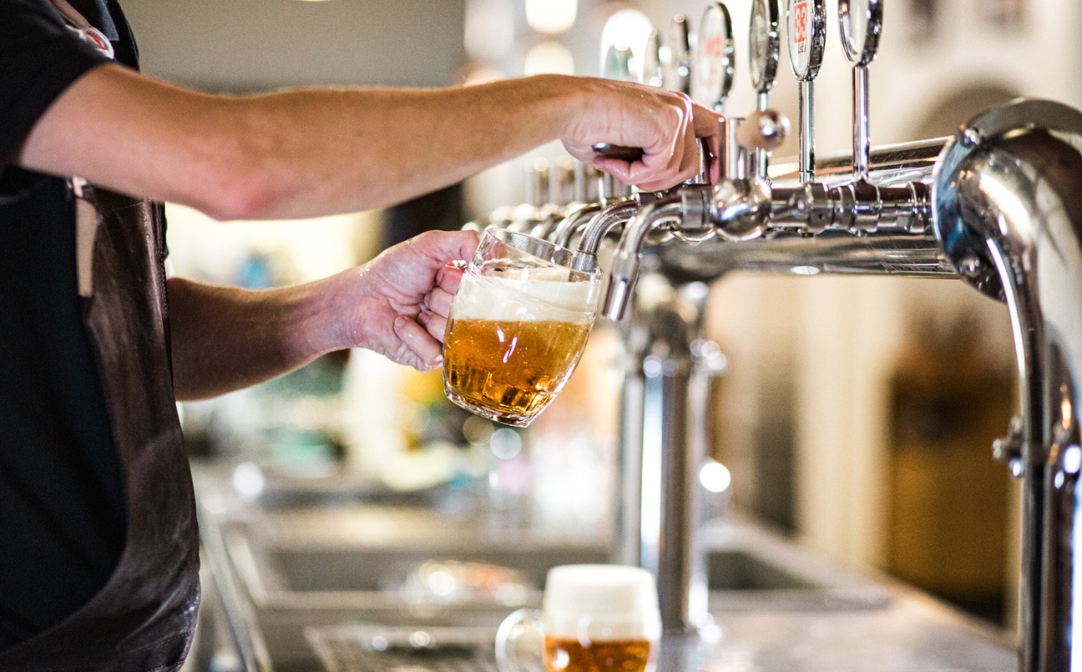
The výčepní, or tapster, is not simply a bartender. They are responsible for the final expression of the beer. Their reputation can matter as much as the brewery’s itself.
A skilled tapster understands foam structure, carbonation, pouring speed, glass temperature and line hygiene. They know how to “read” both the beer and the guest standing in front of them.
The same attention given to pouring can be seen throughout the service process.
Glasses are commonly washed by hand to ensure perfect cleanliness. They are chilled carefully before pouring so the beer remains stable and carbon dioxide does not escape too quickly. Beer lines are flushed daily with water rather than left filled overnight.
Even the taps themselves are different. Traditional Czech side-pull taps allow much finer control over foam texture and flow rate than standard bar taps, and inside the nozzle sits a small screen that smooths the bubbles into dense, creamy foam.
Why Czech beer is poured in different ways
Czech pouring styles reveal just how much serving technique can shape flavour.
The most common pour is hladinka, the benchmark Czech lager serve, combining beer with a thick cap of creamy foam for balance and freshness.
Then there is šnyt, a smaller beer with proportionally more foam, often enjoyed quickly while waiting for a train or settling a tab.
Perhaps the most surprising is mlíko, a glass made almost entirely of wet foam. For many first-time visitors, it looks absurd. Then they drink it. Because the foam contains less carbonation, the beer feels softer, sweeter and remarkably refreshing. In Czech pubs, it is sometimes jokingly described as the Czech equivalent of an espresso shot.
The layered řezané pour takes things even further, combining pale and dark lagers in distinct layers. Drunk from top to bottom, it unfolds almost like a progression through different beer styles, moving from pale lager into amber notes before finishing in dark malt richness.
The hallmarks of Czech lager
Czech beer styles are not typically defined by extremes.
Even dark lagers tend to emphasise balance rather than pronounced roast character. Amber lagers showcase malt complexity without excessive weight, while pale lagers combine noticeable bitterness with freshness.
Decoction mashing, expressive yeast strains, soft water, extended maturation and careful pouring all contribute to the character of Czech lager. Together, these elements help create beers that are known for their balance, texture and consistency.
That may be why Czech lager can seem straightforward at first glance. Behind it lies considerable technical expertise, tradition and patience.
Or, as Radim puts it, “We are just slaves for the yeast.”
About the author
Radim Zvánovec is Global Brand Ambassador at Budvar, as well as a brewer and international beer judge. Originally from České Budějovice (Budweis) in the Czech Republic, he grew up surrounded by one of the world’s most celebrated beer cultures.
After many years working in hospitality, Radim developed a deeper appreciation for the craftsmanship behind beer, discovering that its apparent simplicity hides remarkable precision and care. This curiosity led him into brewing, beer education and sensory analysis.
Today, Radim works internationally to share the traditions, techniques and cultural heritage that define Czech lager.
Additional reading
From German lagers to Citra IPAs – the story of American beer
Exploring the history of Belgian beer
