


ProWein Düsseldorf is entering a new era under the leadership of Frank Schindler, a seasoned wine professional with experience spanning every corner of the industry. Ahead of ProWein 2026, we sat down with Frank to talk about his vision for the fair, the role of education in shaping the future and why global trust matters more than ever.
Read on as Rob Crouch, APP Development Manager ESEA at WSET Global, speaks to Frank Schindler DipWSET, CEO of ProWein.
Rob: Frank, you’ve stepped into this role at a time of big change for the industry. What’s your vision for ProWein as it enters its next chapter?
Frank: Regardless of my own person, I believe the trade fair has made a smart and courageous decision by entrusting the further development of ProWein to an industry insider. I am therefore very aware of both the responsibility and the opportunity this entails. I think it is clear that the pace of change has continued to accelerate, and that no one can yet say with certainty what the industry will look like in five years’ time. What is certain, however, is that answers must be found to new questions – whether in production, marketing, or trade. This applies equally to established businesses and to newcomers.
For more than 30 years, ProWein has stood for professionalism and a strong instinct for giving new developments room to grow at an early stage. One of my key tasks will therefore be to stay close to the pulse of the wine and spirits industry and to identify these trends. Beyond that, it is our responsibility to provide orientation through a clear stance and to build trust. For me, this also includes creating an environment that allows for dialogue and strengthens cohesion within the industry.
My vision is to develop ProWein from a three-day trade fair into a high-reach platform that enables future-proof business. A key element of this is the new ProWein Agora, which I see as the intellectual and emotional heart of the fair – 42 international speakers and 13 hours of live content designed to proactively shape the future, provide inspiration for new solutions, and showcase innovation. All of this will be professionally recorded and made available free of charge to all participants after the fair.
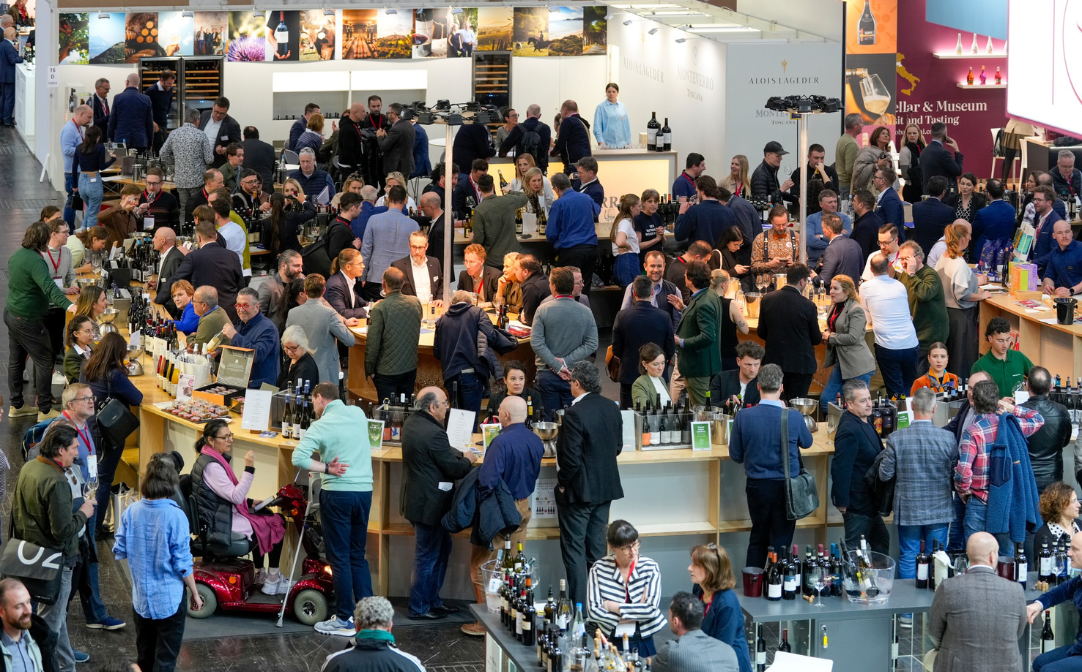
Images: Andreas Wiese / Messe Düsseldorf
Rob: You’ve worked across almost every link in the wine chain - producer, importer, distributor. How does that experience influence the way you lead ProWein today?
Frank: I have a very strong, proactive team that knows the trade fair processes extremely well and supports me operationally – sometimes even taking the lead in certain areas. I am now very much looking forward to ProWein 2026, as I will experience it with a completely different perspective at my 26th participation.
And because I have known many of the industry players for decades and have always maintained an open exchange with them, I continue to see myself as part of the industry and thus as a mediator between exhibitors, visitors, and the organizer. This allows me to understand the needs of the industry and also gives me a pragmatic approach to change, which must primarily deliver tangible business value.
My international activities have further sharpened my awareness that our solutions must work across markets. Education, inspiration, and trends are therefore not merely add-ons, but fundamental pillars.
Rob: Education seems to be a recurring theme in your vision. Why do you believe it’s so critical for the industry right now?
Frank: I believe in the power of solid, comprehensive education. It is often the foundation that enables people to look beyond their own horizons. And since the industry is currently changing faster than ever, it needs people with know-how, foresight, and vision.
Whether it is climate change, evolving production methods, or shifting consumer expectations, all of these developments require constant adaptation – something that strong education makes possible. Moreover, good education builds trust and enables professionals to communicate more clearly, justify decisions, and engage in global discussions on an equal footing. In times of uncertainty, education therefore becomes a stabilizing force. This is precisely why our Agora stage plays such a central role.
Rob: You hold WSET qualifications yourself. How did that shape your career and help you navigate global markets? And do you think having a universal language like WSET’s Systematic Approach to Tasting would have made that easier
Frank: To put it briefly: without the WSET qualification, I would not have become a winery manager six years ago – and consequently, I would not be your interview partner today.
Wine and spirits are highly emotional products, created with great passion and a strong sense of ethics. You need to understand that; you need to speak the language of the industry in order to perceive even the subtle nuances. With its standards, the WSET education has helped to further develop and harmonize this language.
Today, thanks to this training, I tend to think more in terms of style, structure, harmony, and complexity rather than individual aromas. This allows me to categorize a wide variety of products on a meta level and to build my own internal reference framework. And because I completed my qualification back in the early 2000s, the issue of credibility was particularly important to me. Whereas I was often smiled at or lectured in established wine circles before, that never happened again after completing the program.
Rob: WSET is hosting a masterclass at ProWein 2026 about “Exporting Wine with Confidence.” From your own experience, what were the biggest challenges in building trust globally?
Frank: Even today, wine remains very much a people’s business. The philosophy behind the products is a central part of the story surrounding them – and that requires trust. When I look back on the international business developments in which I was actively involved, the focus was often less on the deal itself and more on how people treated one another and how they communicated.
It is an immensely fascinating process, and I cannot recall a single business relationship that lasted over time when the chemistry never truly worked. This means engaging with the particularities of the importing country, immersing oneself in its culture, truly internalizing expectations, and – together with the partner – defining a strategy for building the market. Transparency, consistency, and professionalism were always the cornerstones on which successful cooperation was built. As a result, many of those partners from back then are still good friends today.
Rob: WSET has a strong focus on transforming drinks education in the German market, how do you see education transforming the German wine industry in the years ahead?
Frank: For me, WSET finds itself in a situation similar to ours as a trade fair. Our task is to provide orientation and to continuously adapt education to changing conditions. In my view, this has been a strength of WSET for decades – just as it has been for ProWein.
I am convinced that, for example, the language of wine will continue to evolve further towards the consumer. The challenge will be to apply the vast body of knowledge from education in a very measured way and in a manner tailored to the audience. Buzzwords such as “terroir” and “spontaneous fermentation” are no longer silver bullets. Young people often have short attention spans, which calls for pitch-like, focused communication – something that is not always easy for us, given how many great stories these products have to tell.
Germany, as the world’s largest wine import market by volume, has the potential to establish itself as a knowledge hub for the industry as well. And this is where WSET comes into play for me – not to actively force change, but to act as a pioneer by empowering industry players to make visionary decisions and communicate them effectively. Well-trained professionals are also better equipped to innovate responsibly and communicate values clearly. This will strengthen the German wine industry both domestically and internationally.
Rob: Finally, if you could give one piece of advice to German wine businesses looking to thrive globally in 2026, what would it be?
Frank: If I may use an old metaphor – one that I will also briefly explain afterwards: “The bait should appeal to the fish, not the fisherman.”
The deeper you immerse yourself in the industry, the more your own preferences and taste profiles develop, until you eventually arrive at a personal style. Many markets today differ significantly in their preferences, and consequently in the way they need to be addressed. I have found the greatest success in developing a shared strategy together with partners, even if this means making subtle stylistic and, where appropriate, visual adjustments. In my view, it is essential to place brand management at the center of this process, because a strong brand also provides orientation and builds trust with consumers.
And when it comes to entirely new product categories or styles aimed at a new target audience, I would today seek out young, responsible communicators who are themselves part of that culture. That demonstrates both courage and focus.
ProWein Düsseldorf 2026
Join us at ProWein Düsseldorf 2026 to be part of this transformation and don’t miss WSET’s mainstage masterclass on building global trust in the wine trade.
Interested in attending ProWein? WSET has joined up with ProWein to offer our readers a discounted ticket at just €50 each. Simply use the code 000002shjva3 in the ticket shop to redeem.
