


India’s spirits story is often told through whisky, rum and brandy. A legacy shaped by colonial history and modern mass markets.
But beneath that dominant narrative lies something far older, far more local and quietly resilient. Spirits rooted in forests, coastlines, flowers and fruit. Spirits that have survived bans, misclassification and decades of being dismissed as “country liquor”.
Here we explore two of those spirits, Mahua and Feni.
This blog is inspired by a WSET webinar with Vikram Achanta, Founder and CEO of Tulleeho. You can watch the full webinar recording on the WSET Global Events Hub on YouTube.
India as a growing consumer market
India is now a 400 million-case alcohol market, overwhelmingly driven by dark spirits. It is growing steadily, fuelled by rising affluence and a population where around 20 million people reach legal drinking age each year. While some global markets wrestle with stagnation, alcohol in India is expanding.
Within that growth sits a shift. Premiumisation is accelerating. Consumers are becoming more curious. Bartenders are experimenting. And producers are asking a different question: not what can India imitate, but what can India offer that no one else can.
Mahua and Feni sit squarely in that space.
A spotlight on Mahua
Mahua begins not in a distillery, but in the forest. The Mahua tree, Madhuca longifolia, grows wild across central and eastern India, particularly in tribal regions. For millions of people, it is quite literally the tree of life.
The flower is the key part. Cream-coloured and heavy with natural sugars, it falls to the ground at peak ripeness in early spring. Traditionally, women and children collect the flowers, often after burning the forest floor so the pale petals stand out against the dark earth.
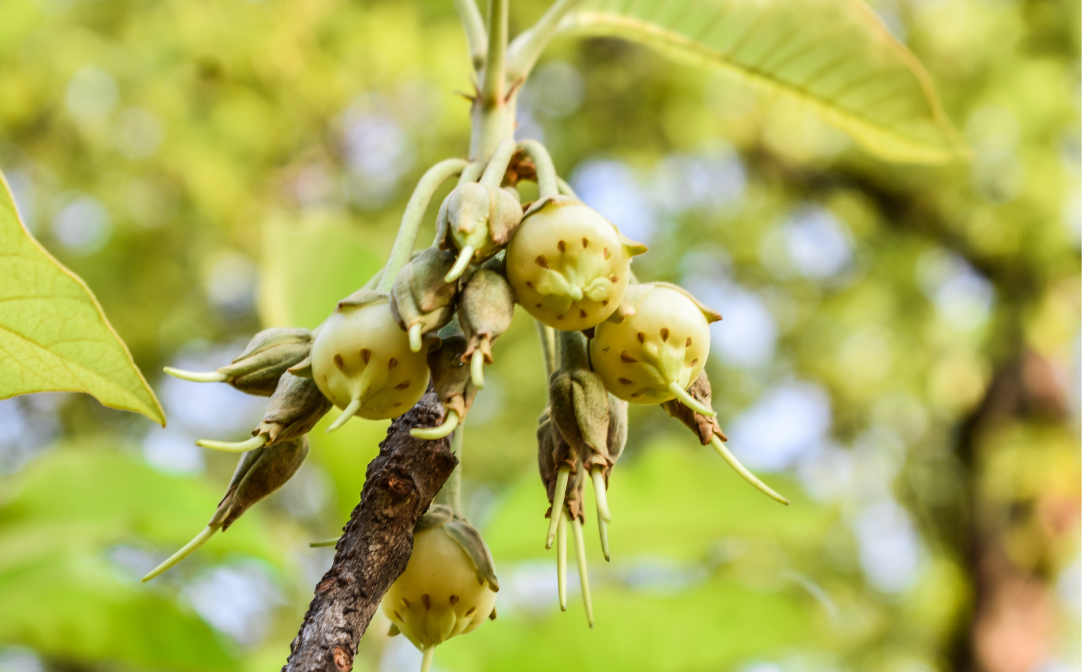
A mahua flower still on the plant
The flowers are then dried and used not only alcohol but for many other uses too. They become porridge, syrup, vinegar and a source of nutrition. Fermentation happens with wild yeast, and distillation takes place in simple, often backyard stills. This is a spirit shaped by environment rather than intervention.
References to Mahua stretch back over two millennia. Ayurvedic texts mention it. Ancient religious writings speak of somras, the nectar of the gods, widely believed to refer to Mahua-based drinks. It may be the only spirit in the world distilled entirely from a flower.
From moonshine to modern bottling
For much of its recent history, Mahua was pushed underground. British colonial laws banned its production in the late 19th century, largely to protect imported spirits. What followed was decades of informal, often illegal distillation. The category became stigmatised, both culturally and commercially.
That is now beginning to change.
A small number of producers are working to commercialise Mahua without stripping it of its identity. Refining the spirit, yes, but also elevating its presentation and reclaiming its story.
One example is Six Brothers Mahura, produced in Maharashtra by a family with over a century of Mahua-making history. The spirit shows pronounced intensity, floral and herbaceous notes, and a smoky edge that has drawn comparisons with mezcal, pisco and even high-end grappa. It is smooth enough to drink neat but structured enough to mix.
Crucially, bartenders are paying attention.
Mahua behind the bar
In Mumbai and beyond, Mahua has begun to appear not as a novelty, but as a base spirit. Bars have built dedicated Mahua menus. Martinis, highballs and local lemon soda variations showcase its character rather than masking it.
This shift matters. Visibility behind the bar changes perception. It moves Mahua from something people whisper about to something they order with confidence.
There are still challenges to producing and distributing this spirit though. Transporting Mahua flowers across state borders is tightly regulated and classification issues continue to limit distribution. There is also the uncomfortable reality of appropriation, with Mahua flowers exported and distilled overseas under different names.
Feni and Goa’s coastal legacy
If Mahua belongs to the forest, Feni belongs to the coast.
Produced in Goa, Feni comes in two main forms: cashew Feni and coconut Feni. Cashew Feni is made from the cashew apple, not the nut. The fruit is collected once it falls naturally, crushed in stone basins, and the juice fermented with wild yeast.
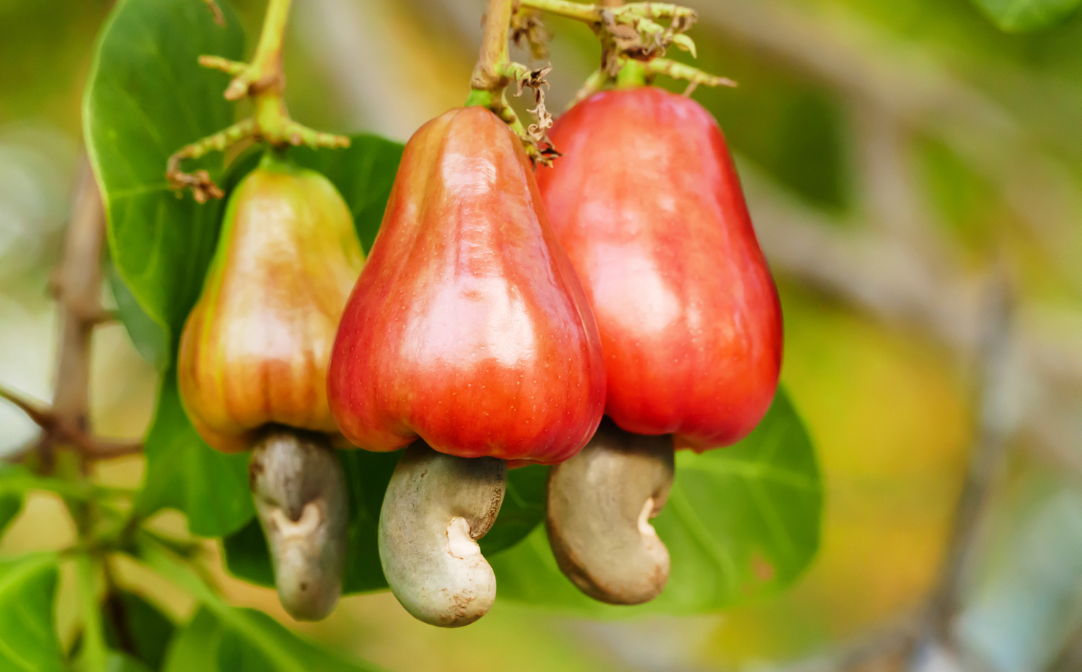
A cashew apple and nut, before separation and crushing
Feni production and consumption
Feni production remains highly seasonal and deeply ritualised. Backyard stills are assembled at the start of the cashew season and dismantled at the end. Offerings are made before distillation begins.
Fermentation is unpredictable. Wild yeast, changing temperatures and time all play a role. One producer famously described it as trying to control three wild buffaloes at once.
The result is a spirit of remarkable individuality.
Cashew Feni is often consumed neat or with lime and soda. Coconut Feni can be infused with botanicals such as ginger, garlic or sarsaparilla, each traditionally linked to specific ailments. There are said to be around 19 recognised coconut Feni variants, blurring the line between spirit and remedy.
One of the most intriguing is Dukshiri Feni, flavoured with Indian sarsaparilla. The word dukh means pain. It may not cure heartbreak, but it has its fans.
A new confidence
Today, Feni is stepping into a new phase. Both cashew and coconut Feni now have Geographical Indication status, offering legal protection and recognition. Visitor centres have opened. Packaging has improved. Cocktail bars are experimenting with it alongside agave spirits, not beneath them.
The pride seen in Mexican bars for mezcal, raicilla or sotol is a useful comparison. Not because India should copy that model, but because it shows what happens when local spirits are given space, language and respect.
What’s next for Indian spirits?
Mahua and Feni are not new spirits, but they after years of being hidden away the challenge lies in the scale of production, access and narrative of these native drinks.
Reclassification as heritage or recognised spirits is a start towards shaping that narrative, and thoughtful commercialisation is another. But it’s further education among bartenders and consumers that will be decisive of their success.
These spirits do not need to be softened into something else to succeed globally. Their power lies in exactly what makes them distinctive: wild fermentation, local raw materials, imperfect consistency and stories that stretch back centuries.
It may indeed only be a matter of time before India’s indigenous spirits take their place on the global stage.
Want to learn more about spirits from around the world? At WSET we offer a range of spirits qualifications to support you at every stage of your learning journey.
Additional reading and watching
An introduction to Romanian wines
Indian native spirits (webinar)
