


Beer foam is often misunderstood, seen by some drinkers as little more than decoration or wasted beer. Yet from a brewing and sensory perspective, foam plays a fundamental role in how beer looks, smells and tastes. In this article, brewer, beer judge and Budvar Global Brand Ambassador Radim Zvánovec explores the science, tradition and service techniques behind great beer foam, from the proteins and hop compounds that stabilise it to the Czech pouring culture that treats foam as an essential part of the drinking experience itself.
Many consumers still see foam as something undesirable, maybe a trick to serve less beer for the same price. In many parts of the world, a beer with a thick, creamy head is still met with the familiar reaction: “Too much foam.” Or “Can you add Flake in it!?” Yet from a brewing and sensory perspective, the exact opposite is true. Good foam is one of the clearest indicators of beer quality.
A stable foam head reflects proper carbonation, clean glassware, healthy foam-positive proteins from malt, well-balanced brewing processes and correct pouring technique. It is not merely decoration sitting on top of the beer, but an integral part of the drinking experience itself. Foam influences aroma release, mouthfeel, flavour perception and even protects the beer from rapid oxidation during consumption.
“A beer without foam is like espresso without crema.”
Just as crema defines the texture, aroma and visual identity of espresso, foam plays a crucial role in how beer is perceived and enjoyed. In some beer cultures, particularly in the Czech Republic, foam is treated almost ceremonially, as a symbol of freshness, craftsmanship and respect for the beer itself.
Understanding beer foam means understanding beer quality. From raw materials and brewing science to dispense systems, glassware and pouring technique, foam represents the point where chemistry, physics and hospitality meet in a single glass.
The science behind beer foam
Beer foam is a complex colloidal structure formed primarily by foam-positive malt proteins, isomerised alpha acids from hops and polysaccharides, which together create a stabilising matrix around CO₂ bubbles. In practical terms, these compounds help trap gas within the beer and keep the foam dense, stable and creamy rather than thin and short-lived.
Stable foam is characterised by small, uniform bubbles, good elasticity and the ability to resist collapse over time. This is commonly measured using the NIBEM Foam Stability Test, which evaluates how long it takes for the foam head to collapse by a defined distance under controlled conditions. During the analysis, beer is poured in a standardised way and an electronic sensor monitors the decrease in foam height over time.
For drinkers, this science has a direct impact on the experience of the beer itself. Stable foam helps preserve aromas, softens carbonation and creates a smoother, creamier texture on the palate. A beer with poor foam stability can quickly feel flat, sharp or lifeless.
From a research perspective, specific hydrophobic proteins (such as LTP1) play a key role by binding at the gas-liquid interface and stabilising individual bubbles. In simple terms, these proteins gather around the bubbles and help stop the foam collapsing too quickly.
Isomerised alpha acids from hops interact with these proteins and strengthen the foam structure, while polysaccharides increase beer viscosity and slow foam breakdown. Together, these compounds help create the creamy, lasting foam associated with high-quality lager and well-poured draught beer. Minerals also play an important role, particularly metal ions such as calcium (Ca²⁺) and magnesium (Mg²⁺), which support the stability of the protein network.
The greatest negative impact on foam comes from lipids (fatty substances), detergent residues, ethanol content, yeast proteinase activity or improperly cleaned glassware. These factors disrupt the stabilising layer around the bubbles and lead to rapid foam collapse. Even tiny traces of grease or detergent can dramatically affect how foam behaves in the glass.
Foam is the result of a balance between beer composition, brewing technology and service quality. Any disruption to this balance is immediately reflected in foam stability and the overall sensory experience.
Wet foam vs dry foam
Not all beer foam is the same. Foam structure, texture and moisture content have a major impact on the drinking experience, flavour perception and overall beer quality.
Wet foam
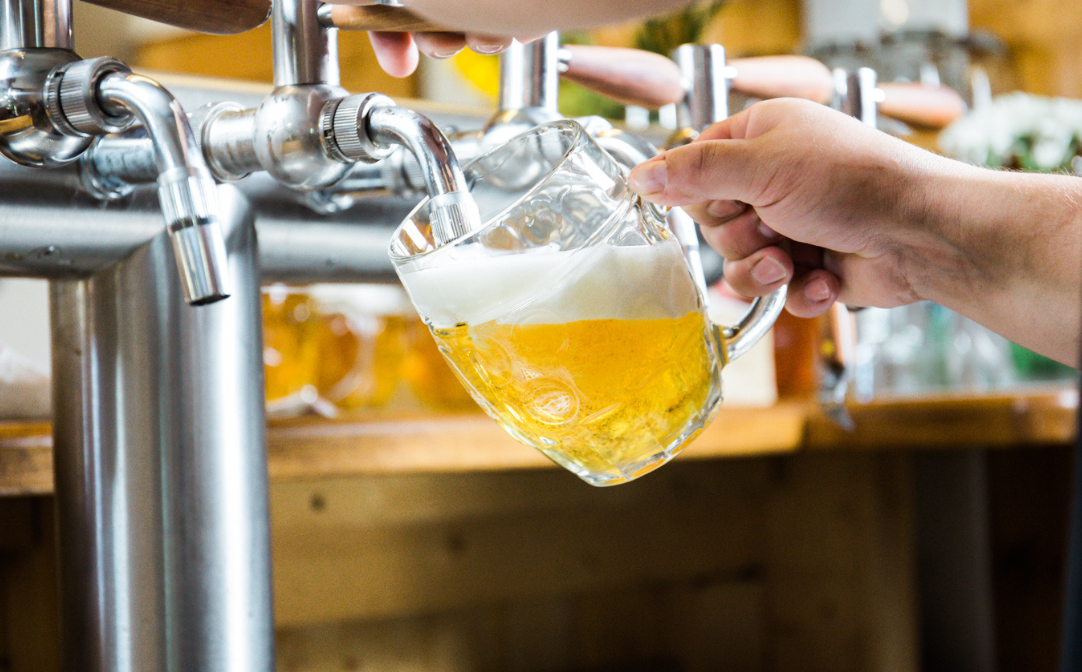
Wet foam is dense, creamy, smooth and highly drinkable. The bubbles are very fine and tightly packed, creating a silky texture that integrates naturally with the beer. This type of foam is typical of properly poured Czech lager, especially when using side-pull Lukr taps.
Wet foam softens carbonation sharpness, enhances mouthfeel, protects aroma compounds and creates a smoother sensory experience. In practical terms, this means the beer can feel rounder, creamier and less aggressively fizzy, even when highly carbonated.
Because wet foam contains more liquid within its structure, it feels almost like a beer pillow rather than acting as a dry cap sitting on top of the beer.
Dry foam
Dry foam is lighter, airier and composed of larger, less stable bubbles. It often forms when beer is poured too aggressively, when carbonation is excessive or when the dispense system is not properly balanced. Dry foam tends to collapse more quickly and provides less protection for aroma and carbonation stability.
In sensory terms, dry foam can feel coarse, sharp, bitter and disconnected from the beer itself. Instead of contributing positively to texture and flavour balance, it may create a harsher drinking experience.
Why Czechs are so obsessed with foamy lagers
To many visitors, Czech beer culture can seem unusual at first glance. A freshly poured lager often arrives with a thick, creamy foam head that would be considered “too much foam” in many other countries. But in the Czech Republic, foam is not seen as wasted space. It is considered an essential part of the beer.
Czech lager is brewed specifically to support rich, stable and creamy foam. Soft water, decoction brewing, long cold maturation, Saaz hops and traditional lager yeast all contribute to foam stability and texture. The beer is therefore designed not only to taste good but also to pour beautifully.
Equally important is the Czech approach to beer service. In Czech pubs, pouring beer is traditionally viewed as a craft rather than simply filling a glass. Bartenders are trained to control flow, foam density, carbonation release and texture using side-pull Lukr taps and specific pouring techniques. The goal is to create “wet foam”.
“Foam is not the enemy of beer. Foam is part of the beer.”
Images provided by Budweiser Budvar
Glassware: the overlooked quality factor
Glassware is one of the most underestimated factors in draught beer quality. The condition of the glass directly affects CO₂ release, foam stability and aroma perception. Microscopic scratches or contamination can lead to excessive bubbling and unstable foam.
Good cleaning is essential. Residual detergent, grease, lipstick or fats quickly destroy foam by disrupting the protein structure responsible for foam stability. Even tiny traces of grease from food or fingerprints can affect how foam behaves in the glass.
Both hand washing and professional glass washers can be effective if properly maintained and thoroughly rinsed.
Glass temperature also matters. Chilled glasses can benefit foam stability, but frozen glasses are not recommended, as ice crystals promote over-foaming and suppress aroma expression.
Don’t fear the foam!
Next time you are served a pint of lager, or any other style of beer, take a moment to appreciate the foam as something beautiful and essential to the experience. Because great beer deserves great foam.
About the author
Radim Zvánovec is Global Brand Ambassador at Budweiser Budvar, as well as a brewer and international beer judge. Originally from České Budějovice (Budweis) in the Czech Republic, he grew up surrounded by one of the world’s most celebrated beer cultures.
After many years working in hospitality, Radim developed a deeper appreciation for the craftsmanship behind beer, discovering that its apparent simplicity hides remarkable precision and care. This curiosity led him into brewing, beer education and sensory analysis.
