


What happens when a drink rooted in tradition meets the creativity of modern mixology? London-based writer and anthropologist Joel Hart explores how sake is being reimagined in cocktails, and why its balance of umami, texture and aroma makes it such a compelling ingredient behind the bar.
Once scarce in the UK - and when it did appear, often served hot enough to mask a low-grade profile - sake now occupies a very different space. The Japanese fermented rice beverage is more often associated with high-end settings: a life-changing pairing in an omakase, or the offbeat, quietly confident choice within a wine flight at one of the world's best restaurants.
But what about cocktails - should mixing high-quality sake with other components be seen as sacrilegious, or might it occupy an important space in the UK's increasing sakemania?
Once scarce in the UK – and when it did appear, often served piping hot to disguise poor quality – sake now occupies a very different space. The Japanese fermented rice beverage is increasingly associated with high-end settings: a life-changing pairing in an omakase, or the quietly confident choice within a wine flight at one of the world’s best restaurants.
But what about cocktails? As bartenders explore how to use sake in cocktails, should mixing high-quality sake with other components be seen as sacrilegious, or might it occupy an important space in the UK’s increasing sakemania?
Why use sake in cocktails?
With dozens of sake-based cocktails listed on Difford’s Guide, from sake sours to martinis and negronis, bartenders are clearly beginning to favour it.
For sake samurai Natsuki Kikuya of the Museum of Sake, this is to be welcomed with caution.
“I’ve always believed that sake is complete in itself,” she says. “It doesn’t need to be mixed. However, I don’t see cocktails as a compromise. Rather, I see them as a different lens through which sake can be experienced.”
For Natsuki, sake’s unique structure of umami, softness and relatively low acidity, alongside its distinctive aromatic range, offers a clear point of distinction for mixologists. All of this, she says, “allows it to integrate beautifully with other ingredients. When used with care and intention – not to mask but to build on its character – it can bring a distinctive dimension to a cocktail.”
It also fits neatly into current shifts in drinking habits. As Josh Black, on-trade specialist at DREAMSAKE, explains, “because it is lower in alcohol, it can be a great solution for designing lower-ABV serves for modern drinking trends and guests who are looking for more conscious drinking alternatives.”
Choosing the right sake for cocktails
The key to mixing with sake lies in understanding its diversity as a category. From light, delicate daiginjo styles to full-bodied, umami-rich junmai, each brings a different set of characteristics to the glass – and to the shaker. Rather than forcing a sake to fit a recipe, the better approach is to let its natural profile guide the drink.
Sparkling sakes can replace sparkling wines in interesting ways, from a Sbagliato-style serve to a lighter, more delicate spritz. Daiginjo, typically highly polished and known for its clean, aromatic profile, tends towards notes of melon, pear and white flowers, with a gentle lift of acidity. This makes it particularly well suited to fresher, more delicate cocktails where those top notes can shine, such as a refined highball or a sake-led take on a French 75.
Junmai, by contrast, retains more of the rice’s natural character and is typically fuller in body, with a more savoury, umami-forward profile. These styles lend themselves to richer, shorter builds and can hold their own in more spirit-forward formats, such as an Old Fashioned or Manhattan-style serve.
As Anthony Yukio, Head Sommelier at Kioku by Endo in London, notes, the breadth of sake means that “most of the time it is a case of finding the right sake to fit the profile rather than forcing it to work. There is the famous phrase in Japan: ‘sake doesn’t fight with food’ – and I think that applies for cocktails too.”
Best sake cocktails and how to adapt classic recipes
The most intuitive starting point is rethinking familiar formats.
A Martini made with a split base of gin and daiginjo retains the drink’s elegance while introducing a softer, more umami-laced finish. A sake Negroni, where sake replaces part or all of the gin, stirred with dry vermouth and a Campari-style bitter, pulls the drink into something rounder and more restrained, the sake's umami (glutamates have been shown to suppress bitter perception) quietly moderating the bitterness.
A sake sour, built with daiginjo, fresh lime and lemon, a touch of cane sugar syrup and egg white, makes for a lighter, fresher take on the classic - the style’s natural elegance and mouthfeel doing the heavy lifting in place of a higher-ABV base.
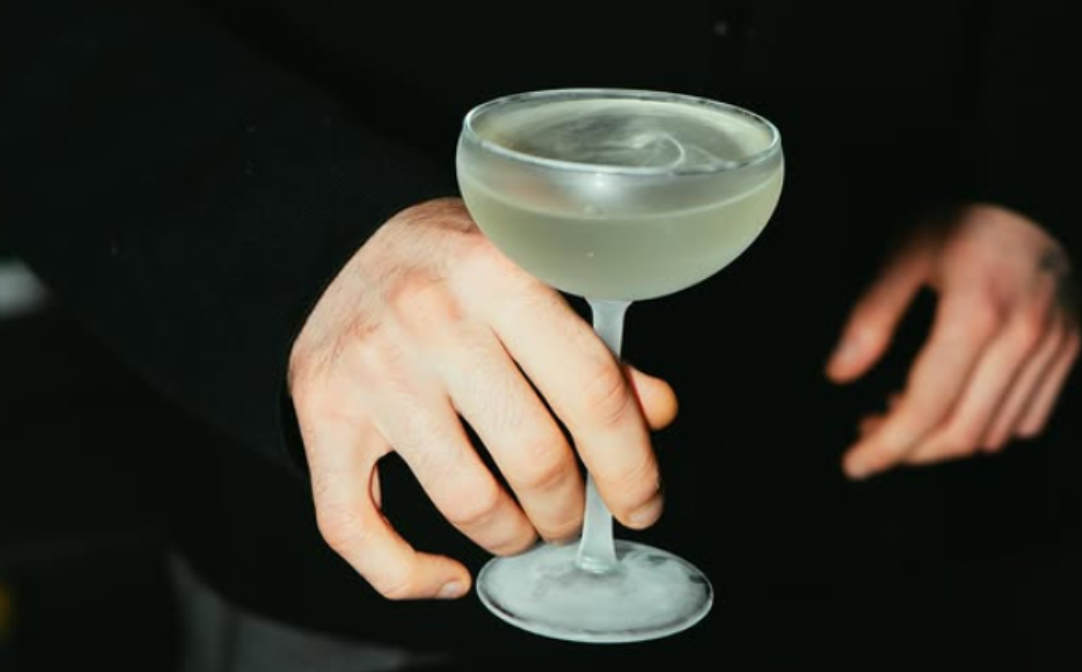
Photo: DREAMSAKE®
Flavour pairings: tea, fruit and umami-led combinations
Tea is a particularly intuitive pairing. Both tea and sake span a spectrum from bright and fresh to deep and earthy, and their shared umami character tends to complement rather than compete. An oolong and daiginjo highball can be clean and refreshing with a lightly smoky edge, while combining rooibos or lapsang souchong with junmai in a shorter serve finds common ground in richer, deeper notes.
Sake’s affinity with fruit also offers scope for experimentation. Stone fruits such as peach, plum and apricot mirror the esters found in many ginjo-style sakes, making them natural companions. A daiginjo paired with fino sherry and a peach aperitif offers a bamboo-style twist with more aromatic lift. More adventurous combinations, such as a highball with fig leaf tincture, aged sake and whisky, can come surprisingly close to the essence of a classic highball while still offering something new. As Yukio puts it, these drinks sit “close to the essence of a simple highball… whilst at the same time being something new and innovative.”
Sake cocktails as a gateway to the category
Whether transforming classics, exploring inventive tea-led serves or experimenting with fruit, these examples demonstrate how sake’s acid–umami balance, supple mouthfeel and aromatic complexity can move beyond the glass and into creative mixology.
The trick is to work with a sake’s natural profile rather than against it, paying attention to its sweetness, structure and aromatic character, and using these as a foundation rather than something to disguise.
“For many consumers, especially outside Japan, it can feel unfamiliar or even intimidating,” Kikuya notes. “Cocktails can act as an accessible entry point.”
Additional reading:
What is sake? A beginner's guide
How does sake get its flavour?
Different types of sake explored
About the author:
Joel Hart is a London-based writer, anthropologist and culture journalist focusing mainly on restaurants, wine and artisanal drinks. His work has appeared in publications including the Financial Times, New York Times, The Telegraph, The Times, Broadsheet, Vittles, Time Out and Pellicle.
